This follows on from my previous blog post about booting ancient OSes on emulators for ancient computers on your Android phone.
Since I still have an extensive collection of vintage DEC hardware, I decided to extend what I had been working on by connecting some vintage hardware up to the emulated system.
The first thing I had at hand was a DEC VT125 terminal - a close relative of the VT100, which includes some added graphics support. A quick power-up verified that it work. Now, to get it to talk to my phone's emulated VAX.
Now, I didn't have any good way of connecting a serial port directly to my phone, but SIMH does support a telnet connection to the emulator's console by doing a command like this (2301 is the TCP port to accept connections on):
sim> set console telnet=2301
Now, to create a telnet session from my VT125, I grabbed a Xyplex MAXserver 1640 from my bastement. These are similar to a vintage DECserver, but support telnet (and many other things) in addition to the usual DEC-specific LAT protocol. Basically, I can hook a terminal up to this, and use it to telnet to a host. It also works the other way around, so that I can hook a system's serial port up to it (such as a console port), use telnet to connect to the MAXserver, and connect to the serial console on the physical machine. This later setup is something we do with systems at work, and is very commonly done, as opposed to connecting serial terminals up to network-attached hosts, like I am trying to do.
For the purposes of this post, I won't go into detail on how to set up a MAXserver, but I basically placed a boot image on a tftp server, told the MAXserver to boot from that image, gave it an IP address, and told it to reset itself to default settings.
To connect the MAXserver to the VT125, I used a RJ45 serial cable (a "roll over" cable) and DB25 to RJ45 adapter, which has the same pinout as a Cisco RJ45 to DB25 DTE serial cable. Ethernet then connects the MAXserver to my home network.
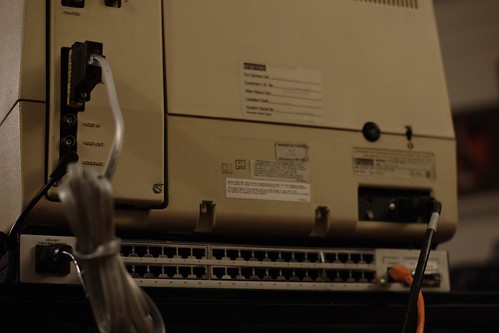
Next, I set my phone to connect over WiFi to my home network, and noted its IP address. After turning on my VT125, booting the MAXserver, and starting up the emulated VAX on my phone. From there, I told the MAXserver to connect to my emulated VAX console:
Xyplex> connect 172.27.3.150:2301
Now, just boot the emulated VAX, and enjoy!

I have more pictures up on my flickr account.
